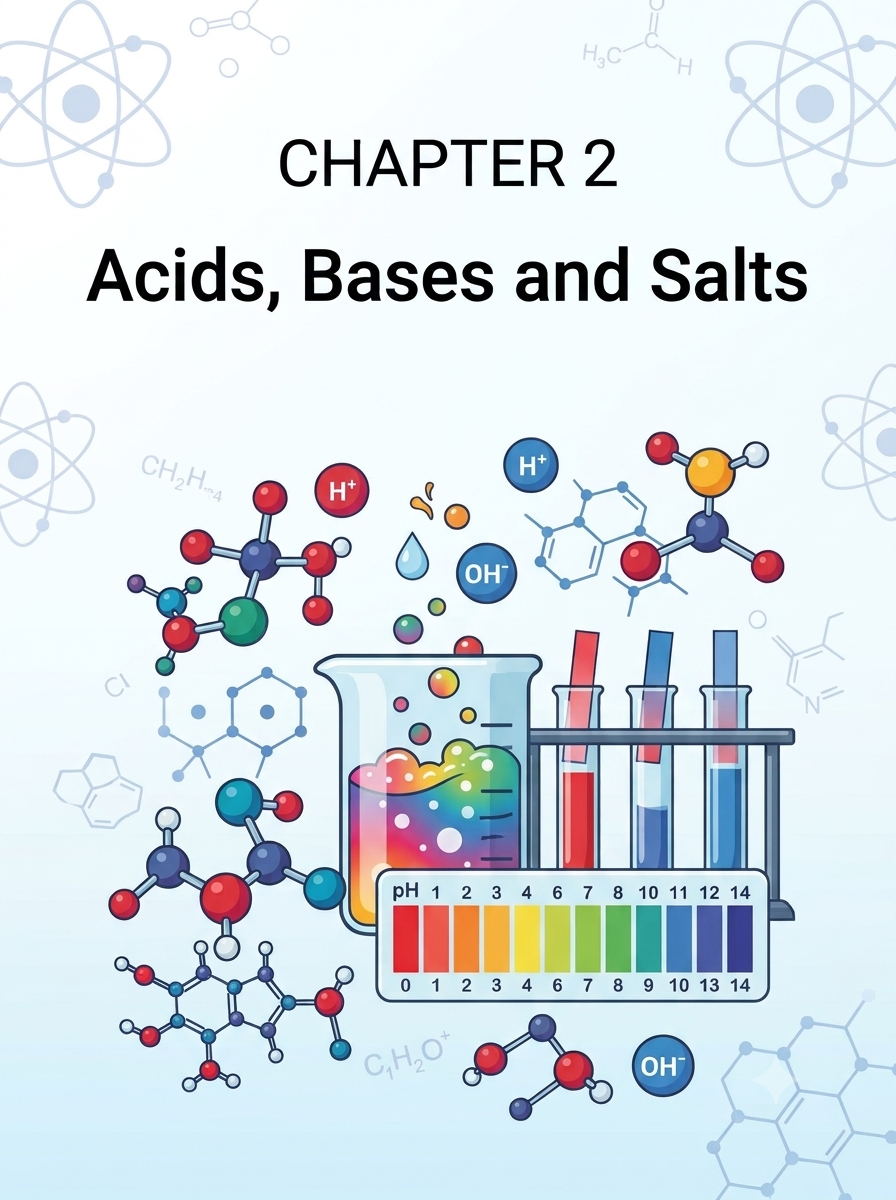
Acids, Bases and Salts
Author: NCERT
"Acids, Bases and Salts," explores the fundamental chemical properties, characteristic reactions, and practical applications of acidic, basic, and neutral substances. The chapter details how natural and synthetic indicators and the pH scale identify and measure acidity or alkalinity. It explains the chemical behavior of these compounds in aqueous solutions, their reactions with metals, oxides, and carbonates, and highlights the preparation, properties, and real-world industrial and domestic uses of key salts.
About this eBook
"Acids, Bases and Salts," introduces the basic properties and chemical behavior of acidic, basic, and neutral substances. It explains how to identify compounds using indicators and the pH scale, details their key chemical reactions, and highlights the preparation and practical uses of essential salts in daily life and industry. Key Summary Points: 1. Properties and Indicators: Acids taste sour and turn blue litmus red, while bases taste bitter and turn red litmus blue. Synthetic indicators (phenolphthalein, methyl orange) and natural/olfactory indicators are also used to test them. 2. Chemical Behavior: Acids react with metals to release hydrogen gas (H2), and react with metal carbonates to form carbon dioxide (CO2), water, and salt. Acids and bases react together in neutralization reactions to yield salt and water. 3. Ions and Dilution: Acids produce hydronium ions (H+ or H3O+) in water, while bases produce hydroxide ions (OH-). Diluting concentrated acids by adding acid to water is a strongly exothermic reaction. 4. The pH Scale: Measures hydrogen ion concentration from 0 (strongly acidic) to 14 (strongly basic), with 7 being neutral. Optimal pH ranges are critical for human digestion, tooth preservation, plant growth, and aquatic life. 5. Everyday Chemicals from Salt: Common salt (NaCl) serves as a raw material to manufacture sodium hydroxide (NaOH), bleaching powder (Ca(ClO)2), baking soda (NaHCO3), washing soda (Na2CO3.10H2O), and Plaster of Paris (CaSO4.1/2H2O).
₹100
Online reading only. Access will be granted after successful payment verification.
Review your order before payment. Google sign-in is required.
✓ Read on mobile, tablet and desktop
✓ Secure online reading
✓ No physical delivery required